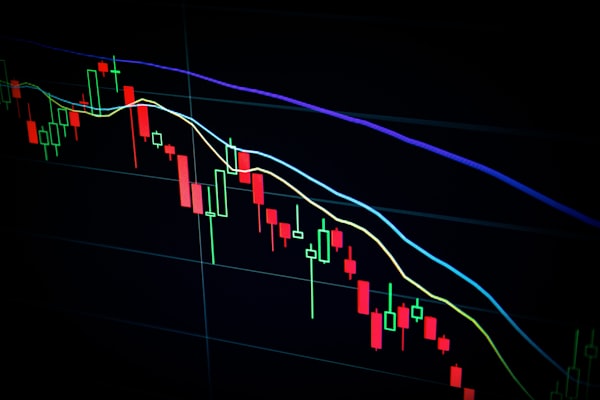
Mean Reversion vs. Trend Following on Leveraged ETFs: Why the Rules Change at 3x
Trend following and mean reversion behave very differently on leveraged ETFs like TQQQ — and understanding the structural reasons why can be the difference between capturing volatility systematically and getting ground down by it.

If you've spent any time trading leveraged ETFs, you already know they don't behave like normal instruments. A 3x fund like TQQQ doesn't just amplify your gains and losses — it amplifies everything, including the mathematical decay that quietly grinds against buy-and-hold strategies over time. That's why the debate between mean reversion and trend following looks completely different once leverage enters the picture.
How Leverage Changes the Game
Trend following is built on a simple premise: assets that are moving tend to keep moving. Buy breakouts, ride momentum, exit when the trend reverses. It works reasonably well on equities, commodities, and currencies over long time horizons. But leveraged ETFs introduce a structural problem that punishes trend followers: volatility decay.
Because leveraged ETFs reset daily, any sequence of up-and-down days erodes value even when the underlying index ends roughly flat. A 10% up day followed by a 10% down day on a 3x fund doesn't get you back to even — it leaves you below where you started. The more choppy the market, the worse the drag. TQQQ specifically, which targets 3x the daily return of the Nasdaq-100, can lose meaningful value during sideways or volatile periods even when QQQ itself treads water. This decay is baked into the math of daily rebalancing — it isn't a bug in a particular product, it's an inherent feature of the structure.
This doesn't mean leveraged ETFs are useless. They've made fortunes for holders during sustained bull runs. But it does mean any strategy that treats TQQQ like a normal trending asset is fighting a structural headwind that compounds every single day.
Why Trend Following Struggles on TQQQ
Classic trend-following signals — moving average crossovers, breakout systems, momentum factors — tend to underperform on 3x leveraged instruments for a few interconnected reasons.
First, the whipsaw problem is magnified. When a trend signal triggers a buy on TQQQ during a choppy market, volatility decay is already eating into returns before the trade has time to develop. Each false breakout costs more than it would on the underlying index. A stop-loss that looks reasonable on QQQ can get triggered multiple times in a single week on TQQQ, with small losses accumulating quickly.
Second, position sizing becomes treacherous. Trend followers typically size positions based on volatility estimates, but TQQQ's realized volatility can spike dramatically during corrections. A position sized for normal TQQQ conditions can turn catastrophic during a genuine downturn — TQQQ's historical maximum drawdown has exceeded 75% during major bear markets. By the time a trend reversal signal fires, the damage is often already done.
Third — and this is the key structural point — leveraged ETFs tend to mean-revert on shorter timeframes more reliably than they trend. The daily reset mechanism creates natural oscillation around fair value. When TQQQ is down 8% in a session, it's statistically more likely to recover some of that move than to continue falling at the same rate indefinitely, at least in the near term.
Mean Reversion: Playing to the Instrument's Nature
Mean reversion strategies flip the script. Instead of betting that momentum will continue, they bet that extreme moves will partially reverse. On leveraged ETFs, this aligns naturally with the instrument's underlying mechanics.
Grid trading is one of the most systematic ways to implement mean reversion on a volatile instrument. A grid strategy places buy orders at regular intervals below the current price and sell orders above it — capturing the oscillation rather than trying to predict direction. When TQQQ drops 5%, a grid system buys. When it recovers, it sells. The goal isn't to call tops and bottoms. It's to profit repeatedly from the swings that leverage creates.
The calibration challenge is real. Too tight a grid, and transaction costs and slippage eat the profits. Too wide, and the strategy misses most of the moves. The number of grid levels also matters enormously: a shallow grid has too little capital deployed to be meaningful; an overly granular grid requires significant capital and creates execution complexity.
One refinement that changes the math significantly: using a geometric grid rather than a linear one. A linear grid places orders at fixed dollar intervals. A geometric grid places them at fixed percentage intervals. On a volatile instrument like TQQQ, geometric spacing means each grid level represents the same relative move rather than the same absolute one. This is more natural for percentage-based instruments and avoids clustering trades at arbitrary dollar levels that may never be relevant again after a major price shift.
Putting Numbers to the Approach
StratBeacon's TQQQ volatility scalping dashboard is built around an 88-level geometric grid strategy specifically calibrated to TQQQ's historical volatility profile. The 88 levels aren't arbitrary — they reflect enough granularity to catch frequent small moves while spanning a price range wide enough to stay active across a variety of market regimes. The geometric spacing ensures the strategy behaves consistently whether TQQQ is trading at $30 or $80.
In backtests, this approach has targeted approximately 30% CAGR with a maximum drawdown of around 14%. For context, TQQQ buy-and-hold has seen drawdowns exceeding 75% during severe bear markets. Those are backtest results, not forward-looking guarantees — but the structural logic behind the drawdown reduction is real. A grid strategy that's actively harvesting volatility is inherently more defensive than a passive position in a 3x leveraged fund, because it's continuously selling into strength and buying into weakness rather than riding the full arc of every correction.
This isn't a passive set-it-and-forget-it system. It requires monitoring, periodic rebalancing, and adjustment as market conditions evolve. But for traders willing to engage actively with TQQQ's volatility — rather than just hoping the trend lasts long enough — a disciplined mean-reversion grid approach offers a meaningfully different risk/reward profile than trend-following methods on the same instrument.
The core takeaway is this: mean reversion and trend following aren't just different strategies — on leveraged ETFs, they operate on fundamentally different assumptions about how these instruments actually behave. Trend following assumes persistence; leveraged ETFs are structurally inclined toward decay and oscillation. Mean reversion assumes oscillation; leveraged ETFs, especially those tracking a liquid underlying like the Nasdaq-100, exhibit exactly that. A grid strategy captures value during the roughly 70-80% of market time that isn't a strong trending regime — and that frequency advantage compounds over time.
If you're trading TQQQ, or seriously thinking about it, it's worth asking whether your strategy is fighting the instrument's structure or working with it. The backtest numbers suggest that working with it pays better. Explore how a structured geometric grid approach works in practice at stratbeacon.com.
Past performance of any backtest or strategy does not guarantee future results. Leveraged ETFs involve significant risk of loss and are not suitable for all investors.